

THE LATEST / KEEP
Everything you need to organize, clean, and maintain your home.
Organize Your Kitchen
The Kitchen, Organized: A Room-by-Room Guide to Where Everything Lives
Filed under: Keep — Systems
There is a particular kind of peace that comes from opening a drawer and finding exactly what you expected to find. Not close to it. Not "somewhere in there, probably." Exactly what you reached for, resting where your hand already knew to go.
That peace is not decorative. It is not the result of a weekend spent buying matching bins and calling it done. It is the product of a single, unglamorous principle that most kitchens ignore: things should live where they are used, not where they happen to fit.
This is the difference between a kitchen that looks organized for a photograph and a kitchen that actually functions like one. The first fades within a week. The second holds — because it was built around how you move through the room, not around what looked tidy on a Tuesday.
Below is the full system: the zones, the drawer-versus-cabinet logic, and the item-by-item placement that makes a kitchen run itself.
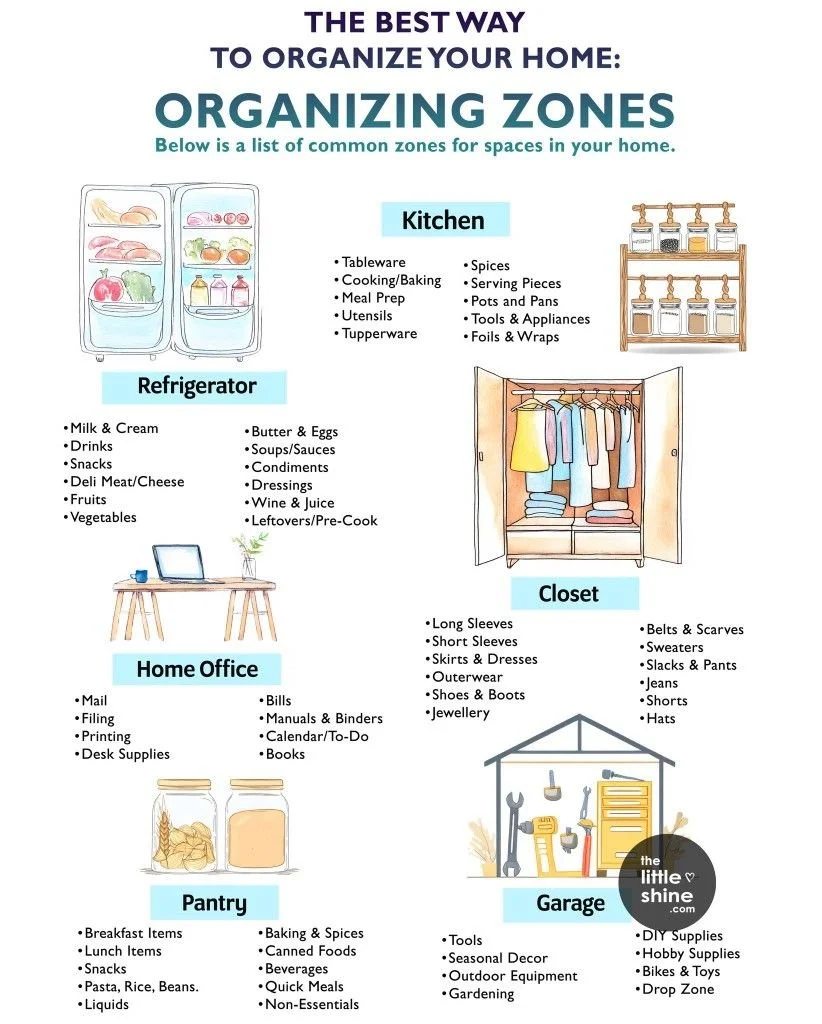
Start With Zones, Not Categories
Most people organize a kitchen the way they'd organize a closet — by type. All the pots together. All the baking things together. All the gadgets in one drawer, sorted by nothing in particular but hope.
The better approach borrows from restaurant kitchens, where every inch of counter and cabinet is assigned to a task, not a category. A kitchen has five to seven natural work zones. Once you identify them, the placement questions answer themselves.
The core zones:
The wash zone — sink, dishwasher, drying rack
The cook zone — stove, oven, the counter immediately flanking it
The prep zone — the largest clear counter span, usually between sink and stove
The cold zone — refrigerator and freezer
The pantry zone — dry storage, whether a closet, cabinet, or freestanding piece
The serve zone — wherever plates, glasses, and serving pieces exit the kitchen toward the table
The coffee/beverage zone — increasingly its own territory, and worth treating as one
Every item you own belongs to one of these zones. The organizing question is never "what category is this?" It's "which zone do I reach for this in?"
The Dishwasher Rule
This is the single highest-leverage placement decision in the entire kitchen, and almost nobody gets it right the first time.
Everything that comes out of the dishwasher should live in the cabinets and drawers directly above or beside it. Not across the room. Not in the "logical" spot near where the item is used. Beside the dishwasher — because the real motion in a kitchen isn't cooking, it's the endless loop of wash, dry, put away, wash again. That loop happens dozens of times a week, and every extra step across the room is a small tax you pay forever.
So, immediately around the dishwasher:
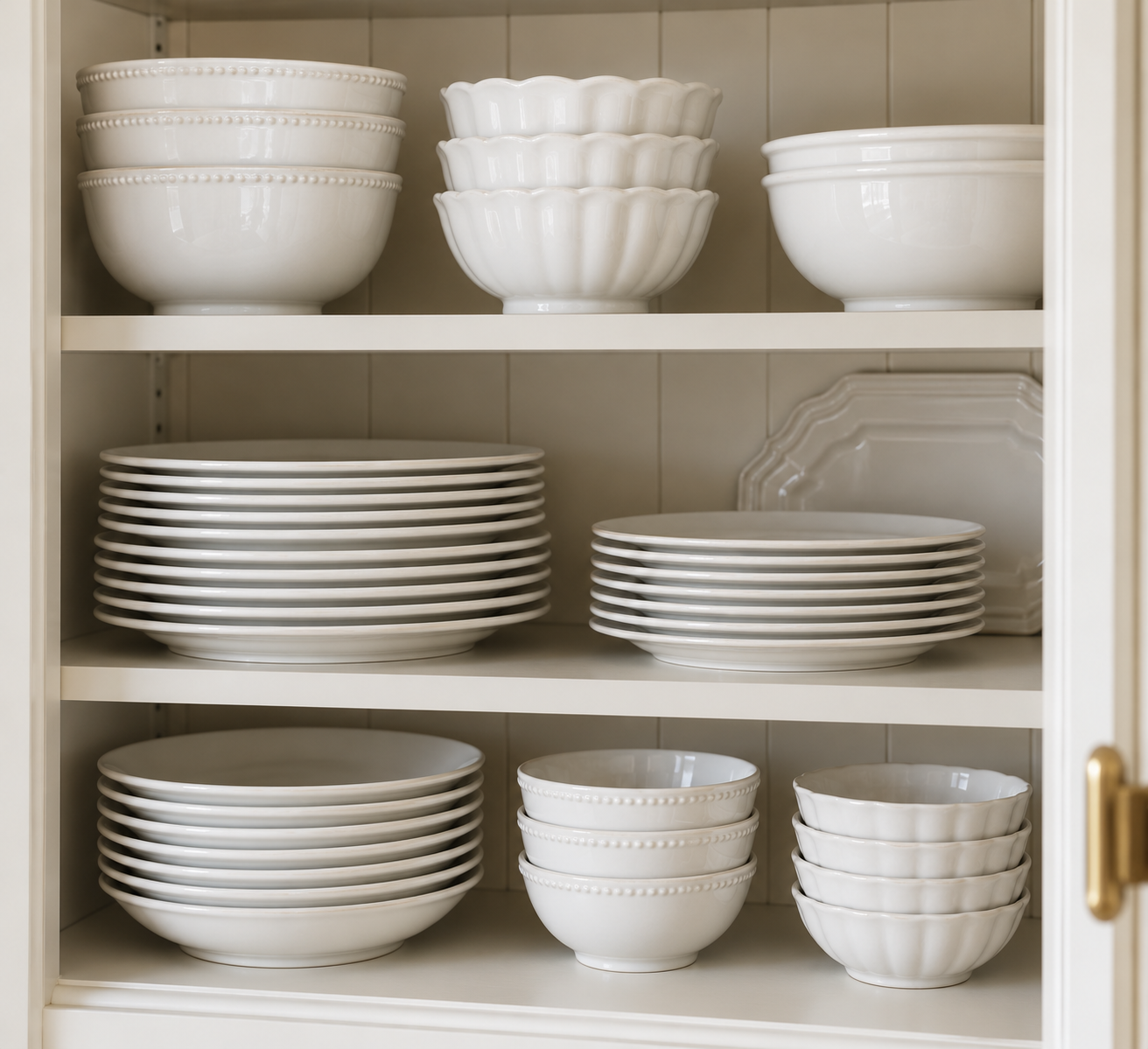
Everyday plates, bowls, glasses in the cabinet directly above
Flatware in the drawer directly above or beside
Mugs nearby, ideally at a height a child or a guest could reach without asking
Cutting boards, if they're dishwasher-safe, in a slim vertical slot within the same reach zone
If your dishwasher sits far from your everyday dish storage because of how the kitchen was originally laid out, this is worth correcting even if it means an unconventional cabinet gets repurposed. The five feet of counter you save yourself, twice a day, for years, is worth more than the cabinet "making sense" by some other logic.
The Stove and Oven Rule
The zone around the stove is sacred, and its sole job is to answer one question instantly: what do I need while something is actively cooking?
Within arm's reach of the stove, without opening a drawer more than one step away:
Cooking oils and the salt cellar
Wooden spoons, spatulas, tongs — in a crock, not a drawer, so there's zero delay mid-sauté
The most-used pots and pans, in the cabinet or drawers directly beneath
Sheet pans and the oven mitt, in the drawer nearest the oven itself
A trivet or two, close enough to grab one-handed
Everything else — the bundt pan, the roasting pan you use three times a year, the extra mixing bowls — moves out of this zone entirely, even if there's technically room. Prime real estate near the heat source is the most valuable square footage in the kitchen. Treat it accordingly, and resist the instinct to fill it with things simply because they're pan-shaped.
Drawers vs. Cabinets: The Actual Logic
This is where most kitchens go wrong, because the instinct is to sort by size — small things in drawers, big things in cabinets. Size is the wrong variable. The right variable is how the item is retrieved.
Drawers are for anything you need to see all at once, from above.
A drawer, opened, shows you its entire contents in a single glance. That makes it the natural home for:
Flatware and everyday utensils
Kitchen tools (peelers, can openers, measuring spoons, whisks)
Linens — dish towels, cloth napkins
Spices, if you use a shallow drawer insert (this is, genuinely, the single best upgrade most kitchens can make — spices stored flat and labeled from above are found in seconds, versus the endless turntable shuffle of a cabinet)
Foil, plastic wrap, parchment, in a shallow drawer with a built-in cutter insert
Everyday cookware that stacks flat — sheet pans, cutting boards, some pot lids
Cabinets are for anything you retrieve by pulling forward or reaching in.
A cabinet is best suited to items that are either tall, bulky, or infrequently needed — things you're willing to bend for or dig for slightly, because you're not doing it six times a day.
Pots, pans, and their lids (ideally on a pull-out shelf so nothing gets buried)
Small appliances used a few times a week — stand mixer, blender
Mixing bowl sets
Bakeware that doesn't stack flat
Dry goods and pantry staples
Serving pieces and platters, which are bulky and occasional by nature
The test, when you're unsure: if you'd naturally look down into something to find it, it's a drawer. If you'd naturally reach into the dark of something, it's a cabinet. Trust that instinct over the size of the item itself.
Cabinet Height Hierarchy
Within cabinets specifically, there's a second layer of logic worth applying — vertical zoning:
Waist to eye level: daily-use items. Everyday glasses, the mugs you actually reach for, plates.
Above eye level: things used weekly or occasionally, and things that are simply light — the everyday plates go up top if that's your only option, but the stand mixer never does, for obvious reasons of safety and effort.
Below waist level: heavy items, and anything you're comfortable bending for — pots, small appliances, pet food, cleaning supplies if they live in the kitchen at all.
This hierarchy matters more than most people realize, because a kitchen that requires a step stool for anything used daily will simply stop being used correctly within a month. The step stool wins. The system loses.
The Full Item-by-Item Placement Guide
For the deliberate among us — and if you're here, you likely are — here is the complete map.
Near the sink / dishwasher
Everyday dishware, glasses, flatware, mugs, dish soap and brush (in a small caddy, not loose on the counter), dishwasher tablets, the good sponge and the ugly sponge kept visibly separate, cutting boards.
Near the stove / oven
Cooking oils, salt and pepper, wooden utensils, the pots and pans in weekly rotation, sheet pans, oven mitts, trivets, a small fire extinguisher if you don't already keep one nearby (worth a mention, not a lecture).
The prep zone counter and drawer beneath it
Knives (on a magnetic strip or in-drawer block, never loose in a drawer with other tools), cutting boards not stored elsewhere, mixing bowls if this is your baking counter, a designated "junk catch" tray for the odds and ends that migrate here — better contained than scattered.
Pantry
Dry goods sorted by category and, ideally, decanted into uniform containers — not for the photograph, but because it lets you see at a glance what's running low. Oils and vinegars not in daily rotation. Baking staples. Snacks at child height if that applies in your home. A small chalkboard or notepad for the running grocery list, mounted just inside the door.
Refrigerator
Top shelf: leftovers and anything that needs to be seen first, so it gets eaten rather than forgotten. Middle shelves: dairy, eggs, everyday staples. Bottom shelf: raw meat, for drip safety. Crisper drawers: produce, separated by ethylene sensitivity if you want to go that far (most don't need to). Door: condiments and anything shelf-stable enough to tolerate temperature swings.
Beverage / coffee zone
Coffee, tea, mugs (a second, smaller set if your dish-zone mugs are elsewhere), a small appliance or two, sweeteners, the electric kettle.
Serve zone, near the table or the kitchen's exit point
Everyday serving pieces, cloth napkins if they live here rather than in a drawer, placemats, the items that make the transition from kitchen to table quick rather than a small expedition.
The category that has no home — and needs one
Every kitchen accumulates a drawer of things that don't fit anywhere: rubber bands, twist ties, the spare key, birthday candles, a tape measure. Give this its own small, contained drawer near the phone-charging spot or the mail landing zone. The goal isn't to eliminate this category — it's inevitable — it's to contain it so it doesn't creep into the drawers meant for something else.
The Maintenance Ritual That Makes It Last
A kitchen organized once and never revisited will drift back to chaos within a season — not from neglect, but from the ordinary accumulation of a life being lived in it. The system holds when it's paired with a small, recurring habit rather than a single heroic weekend.
Once a week, take three minutes to return anything that's migrated out of its zone — the mug that ended up by the coffee maker instead of its cabinet, the spatula that wandered into the utensil crock from the drawer. This isn't deep cleaning. It's simply resetting the map.
Once a season, do a fuller pass: pull everything out of one zone at a time, wipe the shelf or drawer liner, and ask honestly whether each item has earned its spot back. Kitchens accumulate duplicates — the second garlic press, the three sets of measuring spoons — and a seasonal reset is the natural moment to let the extras go.
This is, in the end, the real secret. Not the bins. Not the labels, though they help. The secret is a kitchen designed around your actual motion through it, revisited often enough that it never has the chance to drift too far from the plan.

How To Get Rid Of Stuff
Getting rid of things is about making room—for the things you use, the things you love and, quite literally, for the people who live in your home. We need a house in which the things we own have a reason to be there.
Over time, however, even a well-kept home accumulates things almost imperceptibly: outgrown clothes and toys, duplicate items, gifts we never quite knew what to do with and an astonishing number of cords whose original purpose has long been forgotten.
The trick is learning to make good decisions about what stays, what goes and where everything goes next.
There is a particular kind of clarity that comes from an emptied drawer. Not the frantic, purging kind — the kind that happens slowly, deliberately, with a cup of tea going lukewarm on the counter while you decide, once and for all, whether you still need the good gravy boat you've never used.
Paring back is not about minimalism as an aesthetic. It's about making room — physically and otherwise — for a home that reflects how you actually live now, not how you lived five years ago, or how you imagined you might live when you bought that bread maker.
At a Glance
01 / Understand the Why
Decide what you want to gain from having less—not simply what you want to eliminate.
02 / Start with the Easy Things
Begin with obvious trash, duplicates, broken items and things you already know you no longer want.
03 / Decide What Deserves to Stay
Keep things that are useful, beautiful, meaningful or genuinely difficult to replace.
04 / Make the Hard Decisions
Work through sentimental objects, expensive mistakes, “someday” items and things kept out of obligation.
05 / Sort by Destination
Create clear categories: keep, relocate, sell, donate, give away, recycle and discard.
06 / Get Things Out of the House
A donation pile is still a pile. Give everything leaving your home a deadline and destination.
07 / Make It Harder to Refill the Space
Pay attention to what enters the house so clearing out becomes maintenance rather than a recurring overhaul.
The Process
01 / Start With the Why
There is a subtle-yet-important difference between “What can I get rid of?” and “What deserves space in my home?”
The second question shifts the emphasis away from deprivation. The goal is not an empty house. It is a house where you can find what you need, properly care for what you own and enjoy the things you have chosen to keep.
Too much stuff has practical consequences. Cabinets become difficult to use. Closets require constant rearranging. Storage spaces fill until they can no longer accommodate the things they were intended to store. Cleaning takes longer. Useful things disappear behind things nobody uses.
Before you begin, identify what you are actually trying to accomplish. Perhaps you want:
Kitchen cabinets that are easy to put away
A closet containing clothes you actually wear
A basement that functions as more than overflow storage
Children's rooms they can reasonably keep tidy
Space for hobbies you currently enjoy
Fewer things requiring cleaning, organizing and maintenance
Room to comfortably welcome people into your home
Mary’s note: The best measure of success isn't the number of bags you remove. It is whether the space works better when you are finished.
02 / Go Room by Room
Once you understand the process, work methodically through the house rather than bouncing between whatever catches your attention. Starting with practical spaces builds momentum before you reach the categories that require more emotional energy.
The order I typically follow is:
Bathrooms
Kitchen (pantry and refrigerator first, then drawers and cabinets)
Linens
Children's Clothing
Children’s Toys, Books & Games
Clothing
Books
Office (files, paperwork, technology)
Decorative Objects
Storage Rooms (basement and attic)
Garage
Sentimental Momentos
Do not empty your entire house onto the floor at once. Work in small enough areas that you can completely finish one before moving to another.
A single finished cabinet is considerably more useful than six rooms in various stages of upheaval.
03 / Start With the Easy Things
Decision-making becomes easier with practice, so start where the answers are obvious. Pick one contained area—a bathroom cabinet, junk drawer, pantry shelf or child's dresser—and remove the things requiring very little deliberation.
Trash and empty packaging
Expired products
Broken items you realistically will not repair
Obvious duplicates
Clothing that is badly worn, stained or damaged
Toys with missing or broken pieces
Manuals for products you no longer own
Mystery cords and chargers once you've confirmed they don't belong to something in the house
Products you tried and know you don't like
Things you have already replaced
04 / Decide What Deserves to Stay
Once the obvious things are gone, the decisions become more nuanced. For each item, ask:
Do I use it?
Not theoretically. Do you actually use it in your present life?
Do I love it?
Some things earn their place simply because they make a home more personal or beautiful.
Would I buy it again today?
This is particularly helpful with clothing, decor and kitchen equipment.
Do I have something else that serves the same purpose?
Duplicates aren't inherently bad. Six wooden spoons may be useful; six nearly identical black sweaters may not be.
Is it worth the space required to store it?
A rarely used item that occupies half a closet deserves more scrutiny than something that fits neatly in a drawer.
Would it be difficult or expensive to replace?
There is little sense in purging useful things only to buy them again six months later.
Does it belong to the life we actually live?
Our possessions often represent former hobbies, previous houses, younger children or imagined versions of ourselves. You do not necessarily need to keep equipping a life you no longer live.
05 / Deal With the Hard Categories
Some belongings require more thought because the decision isn't really about the object itself.
Sentimental Items
You do not need to get rid of something simply because it isn't useful. Sentiment is a perfectly legitimate reason to keep something. The question is whether the object itself is meaningful—or whether you are keeping it because you feel that you should.
Give genuinely sentimental things appropriate space. One well-organized memory box is different from an entire basement of objects you never look at. Photographing something before letting it go can also preserve the memory without requiring you to store the object indefinitely.
Gifts
Once a gift has been given to you, its purpose has been fulfilled. Keeping something you don't like or use does not make you more appreciative of the person who gave it to you. Keep the relationship. Release the obligation.
Expensive Mistakes
What you paid for something is already spent. Keeping an unused object does not recover the money. If it has meaningful resale value, sell it.
“Someday” Items
If you have a concrete plan to use something within a reasonable period, keep it. If you have been moving it from closet to closet for ten years, time to let it go.
Items That Belong To Someone Else
Don't make the decision for them. Give the owner a reasonable deadline to collect or sort their belongings, particularly adult children's things stored in your home.
06 / Use the Container Test
Storage itself can help make the decision. Decide how much space you are willing to devote to a category, then let that boundary determine how much you keep. For example:
One shelf for board games.
One bin for children's artwork.
One cabinet for vases.
One box for school memories.
One drawer for workout clothes.
The exact limit doesn't matter. What matters is recognizing that your house is a finite container. If the designated space is comfortably full, adding something generally means choosing something else to remove.
This is far more sustainable than continually buying additional bins, baskets and shelving to accommodate an ever-growing volume of belongings.
Mary’s note: Organizing and editing are different jobs. Organizers make the things you own easier to access. They do not solve the problem of owning more than a space can reasonably hold.

07 / Sort by Destination
As you work, don't create one enormous ambiguous pile. Sort items into boxes with clearly defined destinations:
Relocate Within Home
Give to ______
Sell
Donate
Recycle / Special Disposal
Trash
Be conservative about the sell pile. Selling requires photographing, listing, communicating with buyers and arranging pickup or shipping. For lower-value objects, the time involved can easily exceed the value recovered.
Give yourself a threshold. Perhaps you only sell individual items you reasonably expect to bring $50, $100 or more. Everything below that amount can be donated or given away.
08 / Where Should Everything Go?
Once you've decided to part with something, the next goal is to find the best reasonable destination—not necessarily the theoretically perfect one.
Give directly to someone
This is wonderful when you already know someone who wants the item: children's clothes for a younger cousin, furniture for someone setting up a first apartment or gardening equipment for a neighbor. But ask first. Passing your unwanted belongings to someone who doesn't want them merely transfers the problem.
Donate
Good-quality clothing, housewares, books, toys and small furniture can often go to local charities or thrift organizations. Donate things in a condition you would feel comfortable giving directly to another person. Donation centers should not become a substitute for the trash.
Sell
Resale makes the most sense for items with enough value to justify the effort: quality furniture, designer clothing, newer electronics, collectibles, sporting equipment and certain children's gear.
Consignment can be useful when the item is valuable but you don't want to manage the sale yourself.
Recycle
Paper, cardboard, glass, metal and certain plastics may belong in your municipal recycling stream. Electronics, batteries, textiles and other materials may require specialty recycling.
Check your local requirements rather than assuming something is recyclable.
Special disposal
Paint, chemicals, medications, fluorescent bulbs, propane cylinders and certain batteries should not simply be thrown into household trash. Your municipality or waste provider can tell you where these materials should go.
Trash
Sometimes throwing something away is the correct answer.
A broken, stained, incomplete or unusable object does not become environmentally responsible simply because it sits in your basement for another decade.
Dispose of it properly, learn from the purchase if necessary and move on.
09 / Get It Out of the House
This is the step that separates decluttering from rearranging. Once you have made a decision, complete it.
Put donations directly into the car.
Schedule the furniture pickup.
Send the text asking whether your sister wants the dishes.
List the valuable item for sale.
Take electronics to the appropriate recycling location.
Put actual trash in the trash.
For things you intend to sell or give away, establish a deadline. If they haven't sold or been claimed by that date, donate them.
Keep In Mind
10 / Don't Organize What You Should Eliminate
It is tempting to buy containers before beginning.
Don't.
First remove what doesn't belong. Then group what remains. Only then decide whether you need additional storage.
This often reveals that the house already has plenty of storage; it was simply being occupied by things no longer worth storing.
When you do buy organizing pieces, choose them for a specific purpose and measure the space first.
11 / Stop the Refill
Getting rid of things is only half of the equation.
Pay attention to how things enter the house in the first place.
Before buying something, ask:
Where will this live?
Do I already own something that does this?
Am I buying it for a real need or an imagined one?
Would I still want it if it weren't on sale?
Will maintaining, storing or eventually disposing of it create more work than it is worth?
For children's things, regularly retire what has been outgrown before birthdays and holidays bring another influx.
For clothing, periodically look at what you consistently don't wear.
For household goods, resist buying a storage solution until you've determined that the contents themselves deserve to stay.
You don't need a rigid one-in-one-out rule. You simply need to notice the flow.
Bonus / Create an Exit Station
Designate one small, unobtrusive place for things that are leaving the house: perhaps a basket in the mudroom, a shelf in the garage or a bin near the back door.
When you encounter something you no longer need during ordinary life, put it there rather than returning it to a drawer.
When the container is full, deal with it.
The important part is that this is a temporary holding place, not permanent storage. Establish a routine—perhaps once a month—for emptying it completely.
Parting note: A well-edited home should still contain plenty of things: books you return to, dishes you enjoy setting the table with, children's artwork, inherited furniture, good tools, photographs, collections and objects whose only job is to be beautiful. The point is not to strip a house of personality. It is to clear away enough of the unnecessary that the things worth keeping have room to be used, cared for and enjoyed.
The Art of Letting Go
Why It's Worth Doing
Every object in your home asks something of you. It asks to be dusted, stored, moved, decided about. Multiply that by the hundreds of things tucked into closets and cabinets and the backs of drawers, and it's no wonder a cluttered home can feel loud even when it's silent.
A few reasons paring back matters, beyond the obvious appeal of a tidy shelf:
It restores attention. A home with less in it is a home where the things you kept can actually be seen — the good linens, the well-loved books, the pitcher your grandmother gave you. Clutter doesn't just take up space; it competes for your eye and your care.
It's an act of honesty. Holding onto something "just in case" or "because it was expensive" is often less about the object and more about avoiding a decision. Letting go asks you to be honest about who you are now, not who you were when you bought it.
It makes maintenance possible. A well-run home isn't about owning less for its own sake — it's about owning an amount you can actually tend to. Every added item is one more thing to eventually clean, repair, or manage. Fewer things, cared for well, will always outshine more things, cared for poorly.
It's a gift to your future self. Someone, someday, will have to go through your belongings — likely you, in a few years, or someone you love, someday further off. Editing now is a quiet kindness to whoever does that sorting later.
How to Decide What Stays
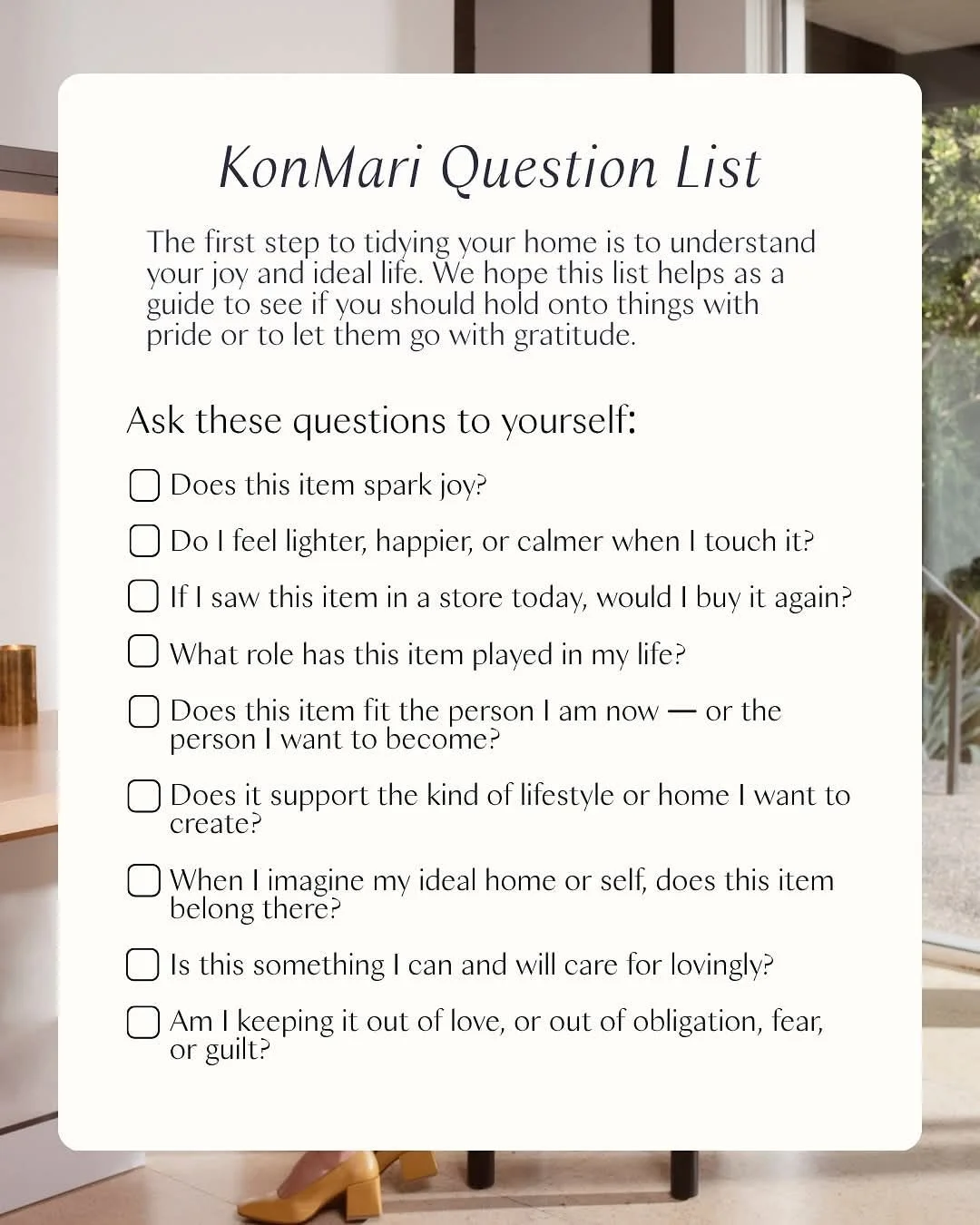
The hardest part of decluttering is rarely the letting go — it's the deciding. A framework helps. Work room by room, or category by category (all books together, all linens together), rather than drawer by drawer. Seeing the full scope of what you own in one category makes the decisions clearer and the duplicates obvious.
For each item, ask, in order:
1. Have I used this in the last year? Not "might I." Not "could I imagine a scenario." Have you, in fact, reached for it. Seasonal and sentimental items get more latitude here — a holiday item only needs to have been used last holiday season to count.
2. Do I have more than one, and does that serve me? Some duplication is sensible — everyday plates for two, plus a set for entertaining. Other duplication is just accumulation: four vegetable peelers, none of them your favorite. Keep the best version. Let the rest go.
3. Would I buy this again today, knowing what I know now? This question cuts through sunk cost quickly. If the honest answer is no, the fact that you already own it doesn't change that.
4. Is it beautiful, useful, or loved — and ideally, more than one of those? This is the closest thing to a north star for what belongs in a considered home. An object doesn't need to be all three. But if it's none of them, it's worth a second look.
5. What is the story I'm telling myself about why I'm keeping this? "I might need it" and "it was a gift" and "it was expensive" are all real feelings, but they're worth naming out loud. Sometimes naming the story is enough to see it clearly — and to release it with gratitude rather than guilt.
A practical note: sort into four piles as you go — Keep, Donate, Sell, and Undecided. Give yourself permission for an Undecided box, but set a rule that it must be resolved within thirty days, unopened. If you haven't thought about what's in it by then, you have your answer.
Where It Goes From Here
Deciding to let something go is only half the task. What happens next matters too — both for your own follow-through and for what becomes of the things you're releasing.
To sell, reserve this for items with real resale value — furniture, designer or barely-worn clothing, quality kitchen equipment, collectibles. Anything below a certain value (a good rule of thumb: if it would sell for less than $20, the time spent photographing, listing, and coordinating pickup usually isn't worth it) is generally better donated.
Furniture and larger home goods: Facebook Marketplace, a local consignment shop, or a neighborhood Buy Nothing group if you'd rather give it away with less friction.
Clothing: consignment stores for higher-end pieces, or resale platforms for everyday brands.
Books, media, and collectibles: specialty resale shops or online marketplaces built for the category — they tend to net more than general marketplaces.
To donate, match the item to the right recipient rather than defaulting to one bin for everything:
Clothing and household goods in good condition to a local thrift shop or shelter — many shelters have specific, seasonal needs worth calling ahead about.
Furniture in good repair to organizations that furnish homes for families in transition; several offer free pickup for larger pieces.
Books to a local library sale, a Little Free Library, or a literacy nonprofit.
Building materials, tools, and fixtures — leftover tile, hardware, light fixtures — to a habitat-for-humanity-style restore, which exists specifically for this category and is criminally underused.
Anything sentimental you're not ready to fully release — consider photographing it before it goes, so the memory stays even after the object doesn't.
To trash, reserve this truly for what's broken beyond repair, incomplete, or unsafe. Before you do, a final pass is worth it: could this be repaired rather than replaced? Could it be repurposed into something you'd actually use? And for anything electronic, battery-powered, or containing chemicals — check for a proper recycling or hazardous waste program in your area rather than sending it to a landfill.
A Closing Thought
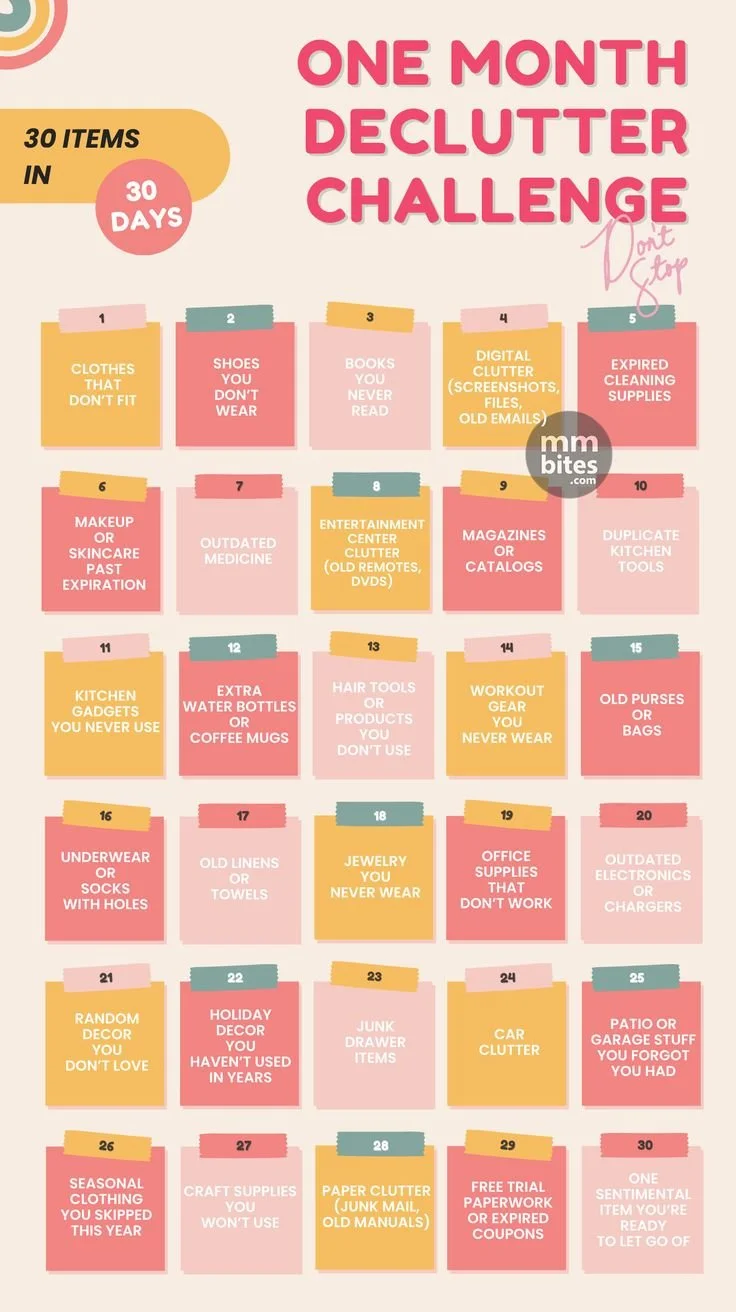
None of this needs to happen in a weekend. In fact, it's better if it doesn't. Give yourself one category at a time, one honest afternoon at a time. The goal was never an empty house — it was a considered one. A home where everything in it earned its place, and you can feel that, even if you couldn't say exactly why.

Digital Decluttering
Digital clutter is the invisible kind — easy to ignore, yet quietly stressful. Overflowing photo libraries, messy desktops, forgotten passwords, and crowded inboxes all add friction to daily life. The good news: a thoughtful digital reset does not require a tech overhaul or an entire weekend. With a simple system and a few steady habits, you can create digital spaces that feel secure, orderly, searchable and easy-to-maintain. Below, a practical, timeless approach you can revisit each year calm the chaos in your photos, files, passwords and email.
01 / plan it out
Before diving into the purge, pause and decide how you want your digital life to function going forward. Systems prevent future clutter and this simple framework will serve as the backbone for everything that follows.
Choose your setup:
One primary cloud storage service
One password manager
One main home for your photo library
Using one platform (Apple, Google, etc.) is highly recommended; the ways that these services integrate makes day-to-day maintenance more manageable.

02 / Device Cleanup
A seasonal refresh keeps devices running smoothly.
Computer Checklist
Clear the desktop (aim for zero icons)
Empty the trash
Remove unnecessary startup programs
Update operating system and backups
Clear browser cache and cookies
Delete unused bookmarks
Phone Checklist
Delete unused apps
Remove old text threads with videos
Close browser tabs
Update software
Review notification settings
03 / password & security reset
This step offers the highest return for both security and peace of mind.
Use a Password Manager
If you are not already using one, now is the moment. Any reputable manager is far better than reusing passwords. A password manager allows you to:
Generate strong, unique passwords
Store logins securely
Access accounts easily across devices
Perform a Security Sweep
Secure these first:
Primary email
Banking and financial accounts
Apple/Google account
Password manager itself
Inside your password manager:
Update weak or reused passwords
Enable two-factor authentication where available
Delete unused accounts
Store secure notes and codes (Wi-Fi, alarm codes, etc.)
Backup and Create an Emergency Access Plan
Follow the two-location rule for backups:
Cloud backup
External hard drive (updated once or twice per year)
Ensure one trusted person could access the following essentials, if needed.
Password manager
List of key accounts
Device passcodes stored securely
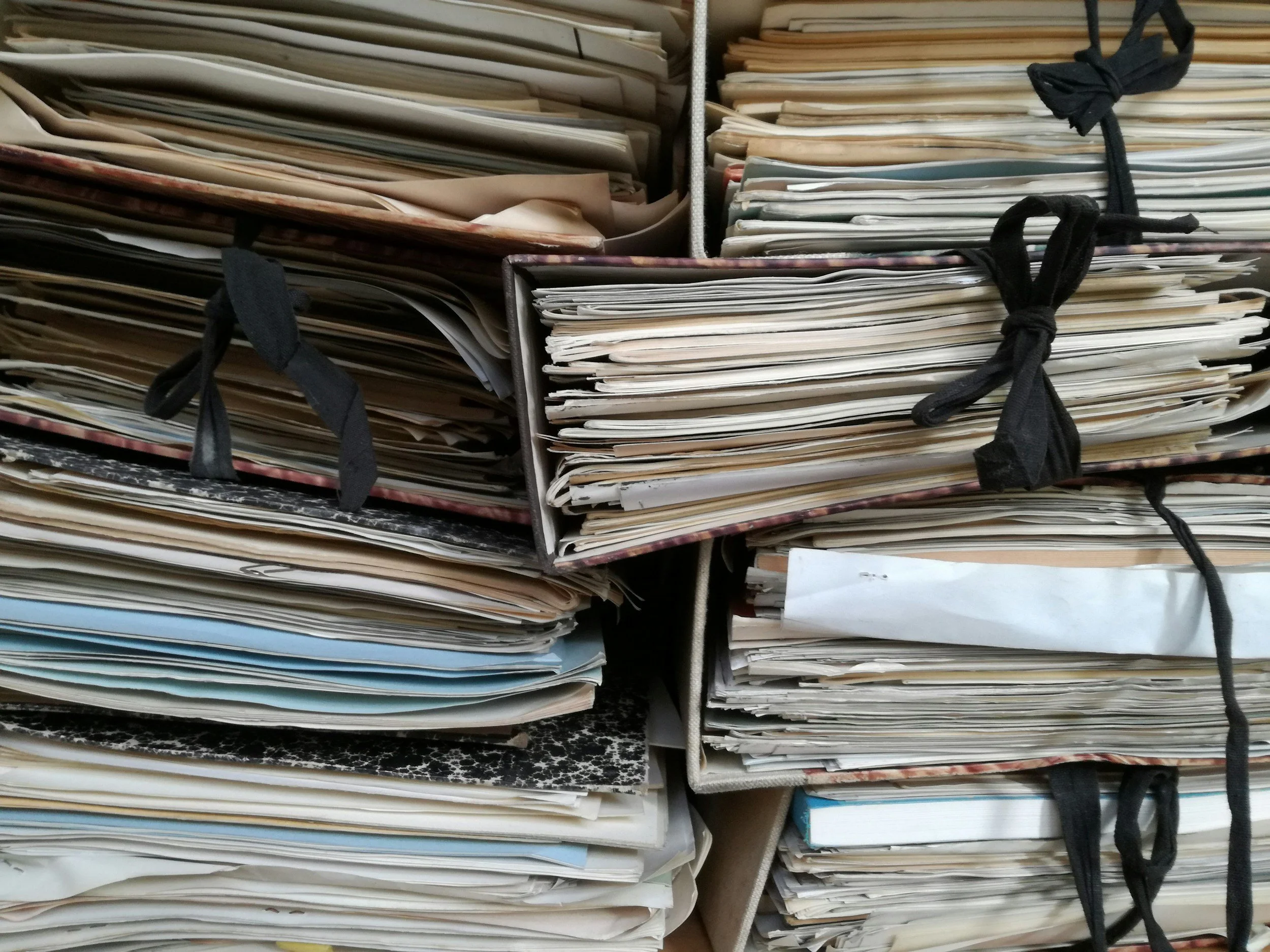
04 / Files & Documents
A tidy file system saves extraordinary amounts of time.
Gather Everything
Collect files across platforms into one common folder or drive:
Desktop
Downloads (this is my digital junk drawer!)
Email attachments
Old cloud services
Expect a temporary mess — consolidation always looks worse before it looks better.
Adopt a Clean Naming Convention
Well-named files are easier to find and sort. Including the date first (“ YYYY-MM-DD Document Name”) will ensure files can be sorted chronologically.
For example:
2026-02-15 Columbine Street Property Tax Statement
2025-09 Greece Trip Itinerary
create a master folder structure
Finances
Tax returns
Pension and retirement records
Permanent life-insurance documents
Legal
Birth, marriage, divorce and death certificates
Adoption records
Passport and immigration records
Wills, trusts, and estate documents
Powers of attorney
Military records
Records relating to major legal matters
School
Professional / Work
Pets
Health
Immunization and allergy records
Provider notes, lab work and imaging
Home
Deeds and property records
Records establishing the cost basis of property
Final loan payoff/lien-release documents
Correspondence
Announcements and holiday cards
Memorial write-ups
Sort, Sort, Sort
Rename and drop files into your new folders one-by-one. For anything you're unsure about sending to the trash bin, ask yourself:
Is this legally or financially significant?
Does it establish ownership, cost, income, payment, or tax basis?
Is there an active warranty, claim, loan, or dispute attached to it?
Could I easily obtain a replacement copy?
Is there a reason I would realistically need this five years from now?
If the answer is no across the board, it's probably time to let it go. There’s no way around it: this is a monotonous job. Turn on your favorite show and start dragging/dropping!
05 / EMAIL
The goal is not inbox perfection — it is inbox calm. Here’s how I keep mine manageable.
No filters or folders. I use gmail and find the search function to be excellent.
Unsubscribe generously to keep incoming emails to a minimum.
Delete (not archive) anything that is not personal.
Anything requiring personal action or response remains in the inbox until it is resolved.
Download pertinent attachments. Email is not the place to store documents.



06 / PhotoS
For most households, photos are the biggest source of digital overwhelm. The goal is not to keep everything — you are preserving memories, not evidence.
Create Simple Anchor Albums
Keep albums broad and evergreen:
Family Yearbooks (e.g., “2026 Family”)
Holidays
Vacations
Kids by Year
House & Projects
Avoid overly specific albums that become difficult to maintain.
Start With the Obvious (and easy) deletes
Open your photo app and search for:
Screenshots
Blurry images
Duplicates
Long, unnecessary videos
Delete these quickly, without overthinking. Short, focused sessions (15 minutes at a time) can prevent decision fatigue. I find this is a great activity for when I’m on a plane.
Use the “Best of the Moment” Rule
For each event or day, keep the best 1-3 photos, mark your true favorites, and delete the rest.
07 / Maintain
Digital clutter returns slowly and quietly. A light routine keeps everything serene.
Monthly (15 minutes)
Empty Downloads
Review recent photos
Unsubscribe from new junk emails
Quarterly (30 minutes)
Check password security alerts
Clean up phone apps
Review cloud storage
Annually (1–2 hours)
Full photo review
External drive backup
Archive prior-year files
Closet Organization
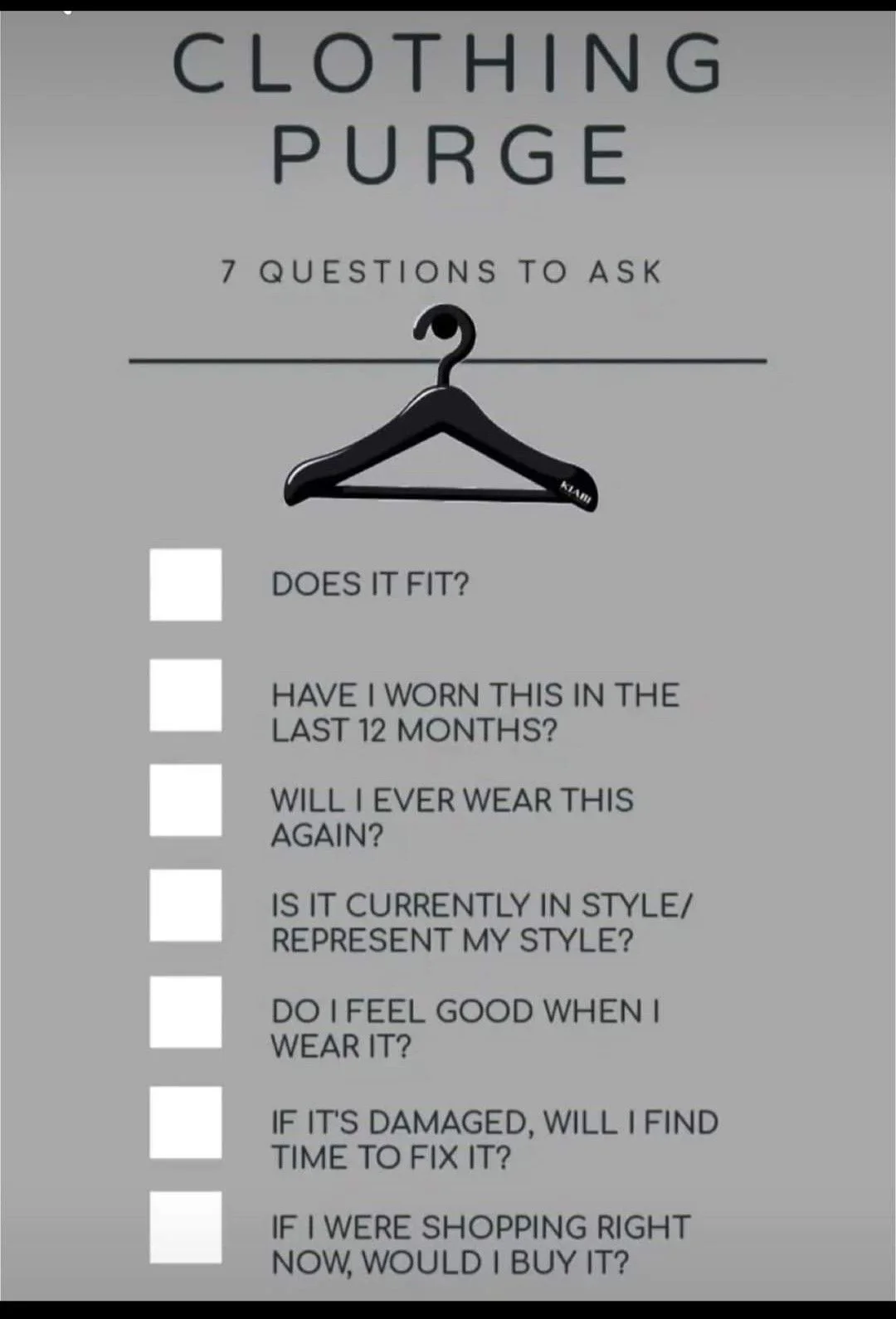
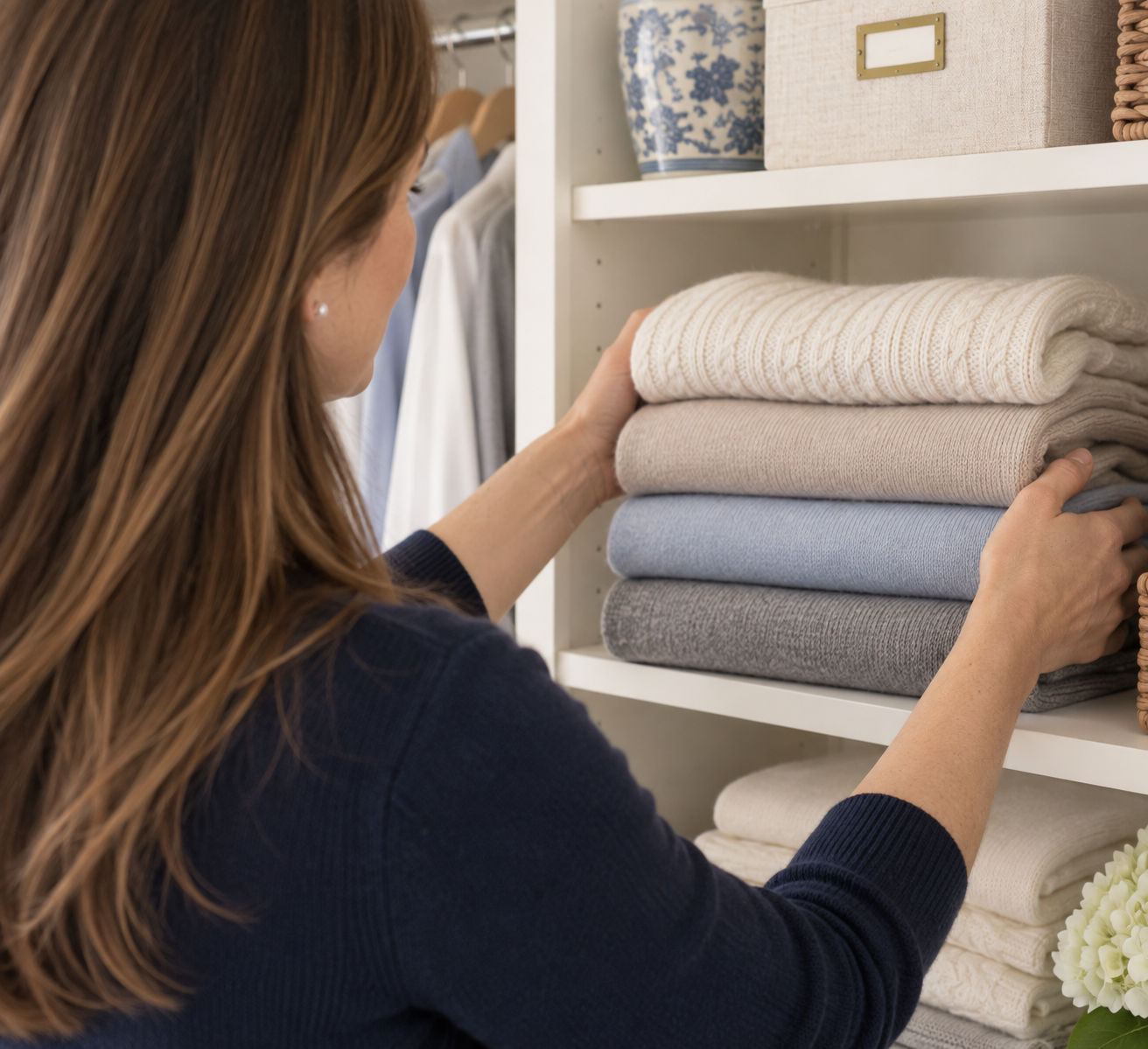
Switching seasons is the best time to be honest with yourself about what you actually used and what’s worth storing for another season.
Get real with yourself…
‘But I spent good money on it’ 👉🏼You spent the money when you bought it, you’re not saving anything by keeping it.
‘What if I want it next year?’ 👉🏼 You didn’t this year, will you really?
FIRST: Empty everything out.
I like doing one section at a time so things don’t get too messy!
SECOND: CLEAN!! Obviously ✨ I prefer a natural household cleaner.
THIRD: Organize your clothes by category, and go through them one-by-one.
FOURTH: Make an alterations pile and a give-away pile
FIFTH: Put it all back and make sure to colonize, light to dark!
INSIDER TIP: Wax paper!! ✨ Rub it on your wood or metal rod, and your hangers will slide easily!
Every item must be able to make at least two outfits.
Title: A Fresh Start: How to Thoughtfully Clear Out Your Closet
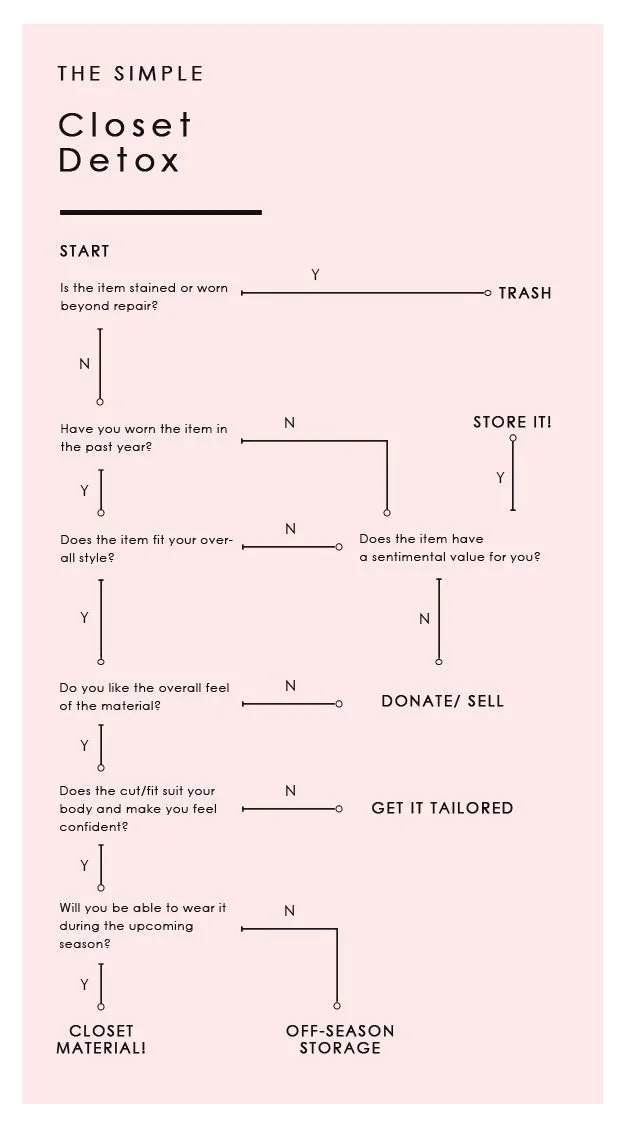
There’s something deeply refreshing about opening your closet and seeing only pieces you love and actually wear. A well-edited wardrobe doesn’t just look beautiful — it makes mornings easier, inspires confidence, and reflects your personal style with clarity. Whether you’re preparing for a new season or simply craving a fresh start, here’s a timeless, step-by-step guide to clearing out your clothing closet with intention and elegance.
Step One: Set the Scene
Before you begin, create a calm and welcoming environment. Open the windows, light a candle, and turn on soft music. Have bins or bags ready for donations, tailoring, and storage. Clearing out your closet should feel like an act of care, not chaos.
Step Two: Remove Everything
Take every single item out of your closet — yes, everything. Laying your wardrobe out in full view allows you to see the full picture and approach each piece with fresh eyes. Use your bed, a clothing rack, or a clean floor space.
Step Three: Edit with Purpose
As you pick up each item, ask yourself:
Do I wear this?
Do I love how I feel in it?
Does it reflect the style I want to embody?
Is it in good condition?
Avoid “just in case” pieces and items that carry guilt. Let your closet reflect who you are today, not who you used to be or who you feel you should be.
Create four piles:
Keep – You wear it, love it, and it fits beautifully.
Tailor/Clean – It’s worth keeping but needs a little help.
Donate/Sell – Still in good shape but no longer right for you.
Store – Seasonal or sentimental pieces to tuck away neatly.
Step Four: Curate Thoughtfully
Before returning anything to the closet, give the space a gentle clean. Wipe down shelves, vacuum the floor, and consider adding lavender sachets or cedar blocks for a fresh scent.
As you hang your pieces back up, group them by category (tops, dresses, trousers) or color for a more elegant, boutique feel. Matching hangers go a long way in creating a calm visual flow.
Step Five: Make a Thoughtful Shopping List
Now that your wardrobe is edited, identify any gaps. Do you need a perfectly tailored white blouse? A classic trench for rainy days? Keep a running list of intentional additions that will enhance your style, not clutter your closet.
A Note on Sentimental Pieces
Some items hold memories more than utility. It’s okay to keep a few — a loved one's sweater, a wedding guest dress — but consider storing them separately, perhaps in a beautiful archival box or under-bed storage. Let your daily wardrobe be practical, not burdened.
Final Thought
A well-tended closet is less about minimalism and more about mindfulness. When each item serves a purpose, you spend less time deciding and more time living. In curating your wardrobe, you’re not just making space — you’re making room for clarity, confidence, and timeless personal style.
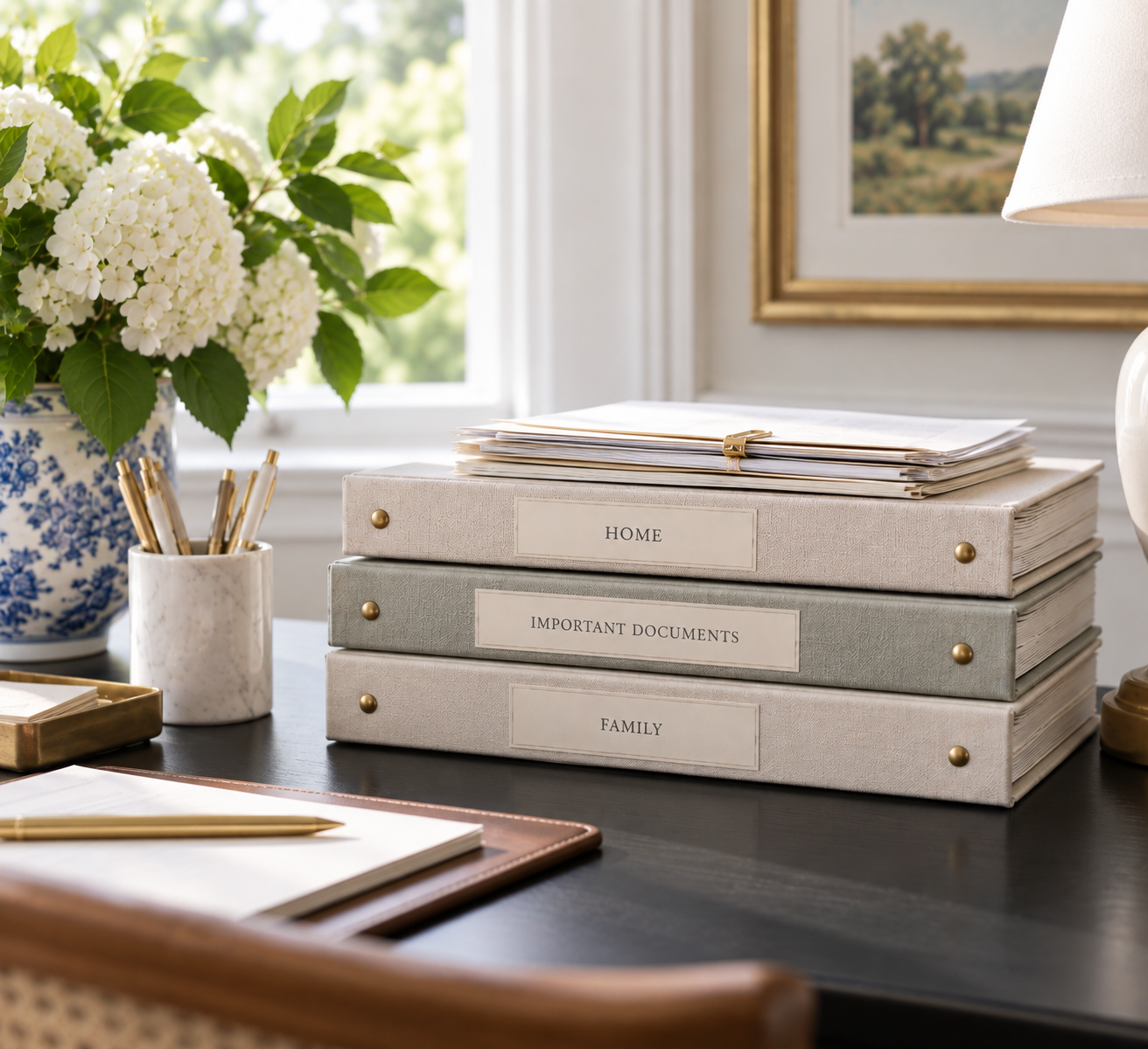
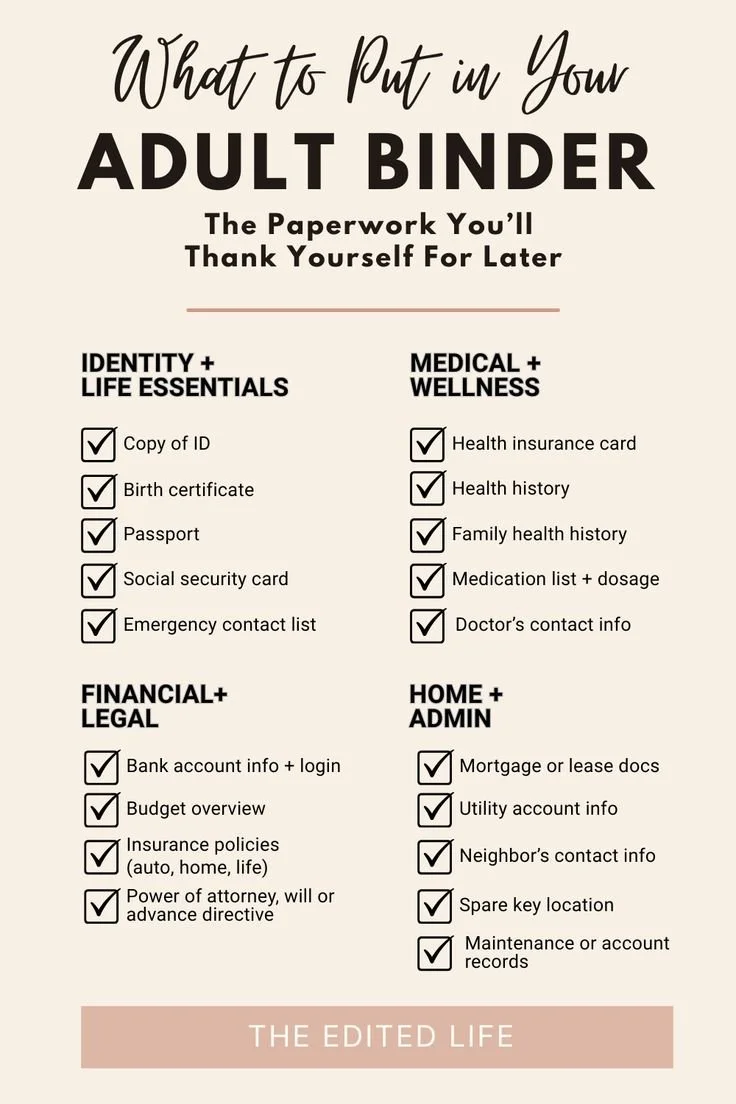
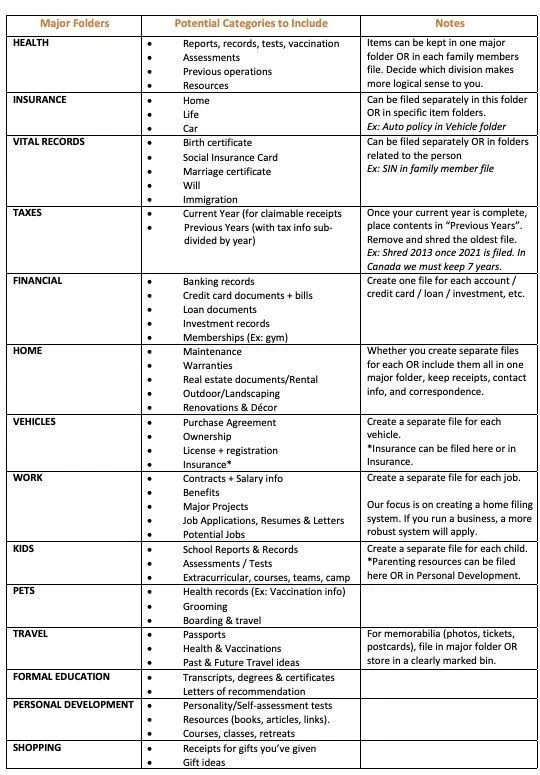
Essential Papers & Files
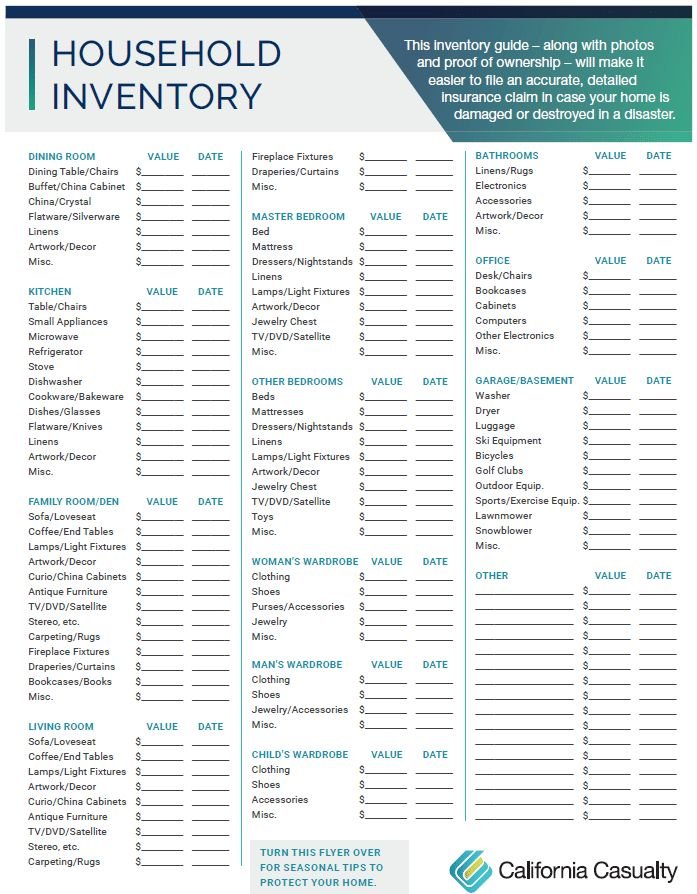
🏡 Home Journal Template
1. Home Overview
Homeowner Name(s):
Property Address:
Date Purchased:
Square Footage:
Number of Bedrooms/Bathrooms:
Year Built:
Home Style:
Lot Size:
2. Key Contacts
ServiceProvider NamePhone/EmailNotesGeneral ContractorElectricianPlumberHVACPainterLandscaperPest ControlCleanerInsurance AgentReal Estate Agent
3. Utilities & Accounts
ServiceProviderAccount NumberContact InfoElectricityWaterGasTrash/RecyclingInternetSecurity System
4. Paint & Finishes Tracker
Room/AreaPaint BrandColor Name/CodeFinishDate AppliedLiving RoomKitchenPrimary BedroomBathroom(s)Exterior
5. Appliance & System Information
ItemBrand/ModelSerial NumberDate PurchasedWarranty InfoRefrigeratorOven/StoveDishwasherWasher/DryerWater HeaterHVAC Unit
6. Renovation & Project Log
ProjectDate CompletedContractorDetails & Materials Used
7. Maintenance Log
TaskFrequencyLast CompletedNotesHVAC Filter ReplacementEvery 3 monthsGutter CleaningTwice a yearChimney InspectionYearlyPest ControlQuarterlySmoke Detector BatteriesTwice a year
8. Warranties & Manuals
Keep copies of important receipts, warranties, and manuals here or note their location.
Refrigerator
Washer/Dryer
HVAC
Security System
Other: ___________
9. Future Projects & Wishlist
Project IdeaPriority (High/Med/Low)Notes
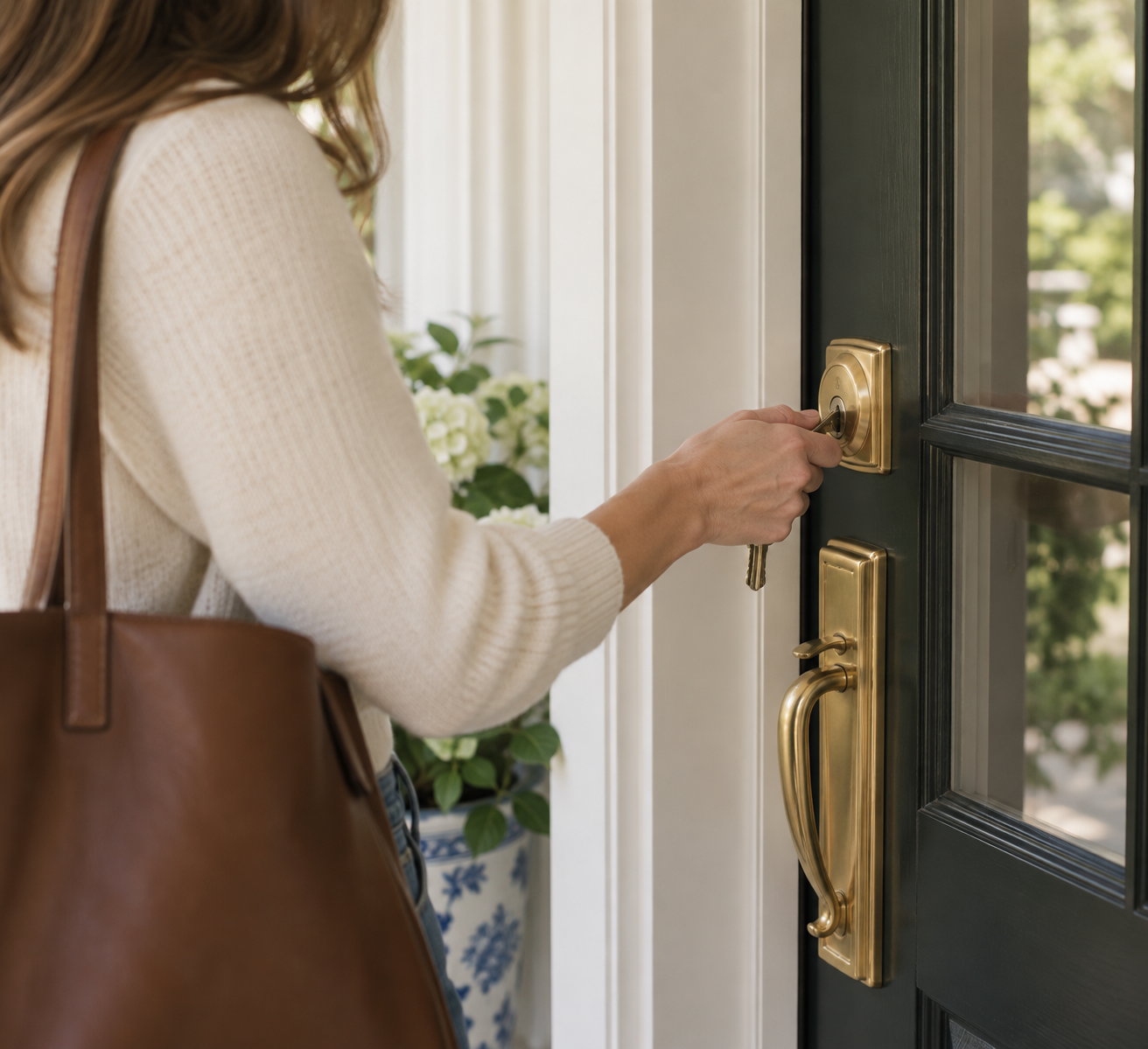
Pre-Travel Home Checklist
Use this checklist to make sure your home is safe and in order before leaving for a trip.
General Home Prep
Clean out refrigerator and dispose of perishables
Take out all trash and recycling
Run the dishwasher and garbage disposal
Do laundry and put away clean clothes
Unplug small appliances and electronics
Turn off or adjust HVAC (set to eco/away mode if applicable)
Close and lock all windows and doors
Set light timers or smart lighting schedule
Set security alarm or notify security company
Notify a trusted neighbor or friend of your travel dates
Leave a key with a friend/family member or neighbor (optional)
Suspend mail delivery or ask someone to collect it
Water plants or arrange for someone to care for them
Adjust blinds/curtains for privacy
Check that smoke detectors and carbon monoxide detectors are working
Outdoor/Home Exterior
Mow lawn or schedule lawn care service
Secure outdoor furniture or store it
Turn off water to outdoor faucets (if needed)
Set up irrigation/timers for outdoor plants
Put away packages, tools, or bikes
Plumbing & Water Systems
Turn off water main (if away for multiple weeks)
Drain pipes or open faucets to relieve pressure (cold weather travel)
Check sump pump (if applicable)
Turn off water heater or set to vacation mode
Energy & Safety
Set thermostat appropriately for season
Unplug electronics and surge protectors
Check that outdoor and motion lights are working
Secure or unplug garage door opener
Confirm smoke detectors are functioning
Final To-Dos
Lock all doors (including garage and sheds)
Take one last walk-through of home
Double-check stove and oven are off
Ensure pets are cared for (boarding/sitter arranged)
Leave emergency contact and travel details with a friend or neighbor
Take photos of rooms (for peace of mind or insurance, optional)

Managing Clutter
“Have nothing in your house that you do not know to be useful, or believe to be beautiful.”
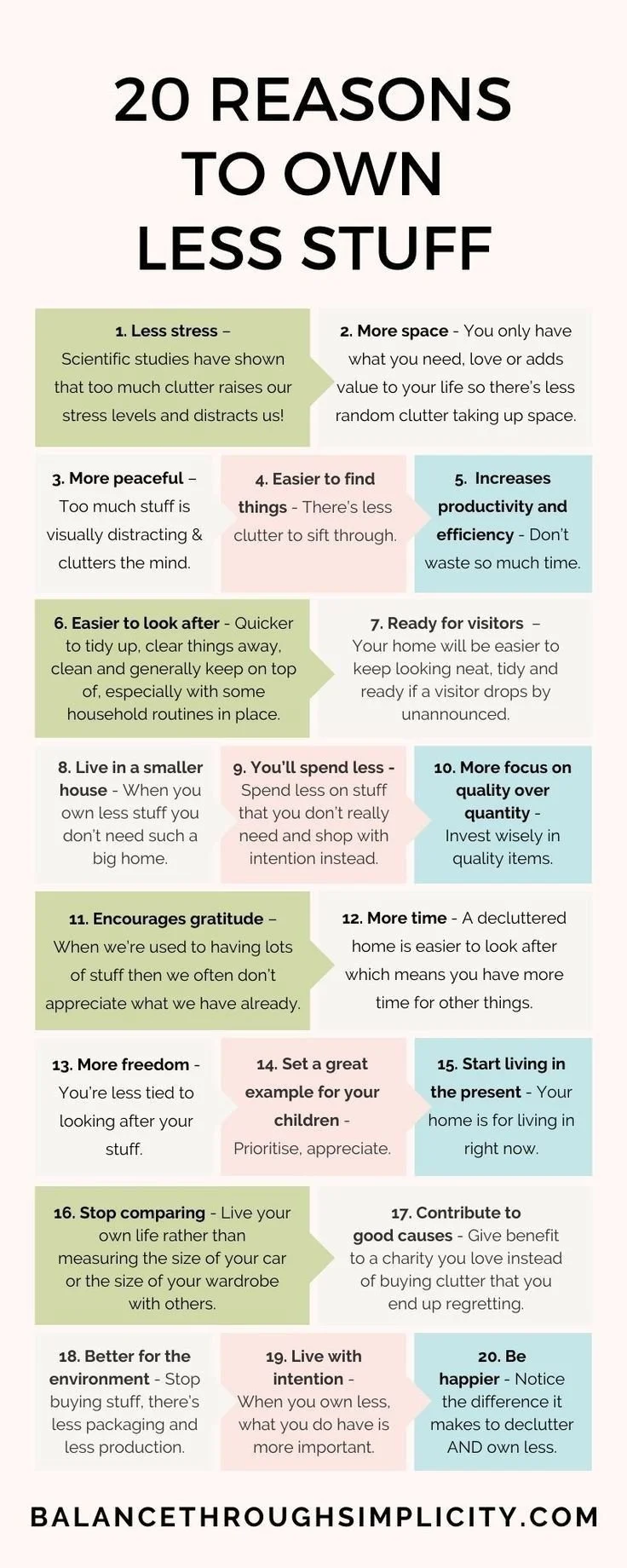
Your story isn’t held in your things; it’s held inside of YOU. ❤️
Delete Photos Daily
If the task can be completed in one minute or less, do it without delay
one in, one out: for every item you bring in, you take one out
Don’t put things down, put them away.
once a week: What’s the trash bag method? 👉 Grab a trash bag and do a sweep of your house, seeing how quickly you can fill the bag. You can choose where the bag is headed—trash, recycling, or a donation center.
The silent to do list...a concept that blew my mind. 🤯
I read about it first in the book Goodbye, Things (by Fumio Sasaki).🫶
The reason why clutter feels so heavy, overwhelming, stressful is because...
The things around us send us messages constantly, like:
▪️Clean me
▪️Tidy me
▪️Return me
▪️Organise me
▪️You haven’t worn me yet
▪️You haven’t used me and I cost a lot of money
▪️You said you’d do this hobby and you haven’t
And more often than not, it’s a negative message.
One that makes us feel bad about ourselves.😰
Feeling like we’re lazy, unmotivated or failures.
That’s why clearing the clutter and the excess feels so good.✨
Removing clutter helps with mood, productivity, more space, more money, relieve stress, better sleep, more present.
Less stress, fewer worries, distractions …
If you don’t use it, let it go.
If it doesn’t add value to your life, let it go.
If you can’t afford it, let it go.
If you don’t want it, let it go.
If it weighs you down, let it go.
Clutter is rarely just about things. More often, it is about decisions postponed, transitions unfinished, and homes that have not been given the time or systems they deserve. A well-ordered home does not require perfection or minimalism—it requires intention.
Managing clutter is less about quick purges and more about creating rhythms that support daily life. When approached thoughtfully, order can feel calm, gracious, and sustainable.
Begin with How You Want to Live
Before sorting a single drawer, pause to consider how each space is meant to function. A home that supports real life will naturally resist clutter.
Ask yourself:
What activities happen here?
What should be easy to reach?
What does not belong in this room?
When function is clear, decisions about what stays—and what goes—become far simpler.
Edit in Small, Manageable Passes
Clutter becomes overwhelming when we attempt to tackle it all at once. Instead, work in contained categories or defined spaces: a single shelf, one drawer, the coat closet.
As you edit, sort items into four simple groups:
Keep: useful, beautiful, or genuinely meaningful
Store: seasonal or rarely used, but worth keeping
Donate: in good condition, no longer needed
Release: broken, expired, or no longer serving you
Progress made in small passes is far more likely to last.
Give Everything a Proper Home
Clutter often forms when items lack a clear place to live. Storage should support habits, not fight them.
A few guiding principles:
Store items where they are used, not where they ought to go
Keep everyday essentials at eye level or within easy reach
Use closed storage for visual calm; open storage for frequently used items
When putting something away is intuitive, order becomes effortless.
Favor Fewer, Better Containers
Bins, baskets, and boxes can be helpful—but only when used with restraint. Over-containerizing often hides clutter rather than solving it.
Choose containers that:
Are proportionate to the space
Reflect the tone of your home (natural materials age beautifully)
Encourage limits rather than excess
A container should define how much you keep—not expand it.
Establish Gentle Maintenance Rituals
A tidy home is maintained through rhythm, not constant effort.
Consider incorporating:
A five-minute evening reset
A weekly surface clear
A seasonal edit at the change of weather
These rituals prevent clutter from accumulating and keep the home feeling quietly composed.
Be Patient with Sentimental Belongings
Some items require time. Heirlooms, children’s artwork, and objects tied to memory deserve thoughtful consideration.
Rather than forcing decisions:
Choose a few meaningful pieces to display or properly store
Photograph items you are not ready to keep physically
Revisit sentimental categories gradually
Respecting the emotional life of your belongings leads to decisions you will not regret.
Remember: Order Is Meant to Serve You
A well-managed home does not feel sparse or strict. It feels welcoming, lived-in, and quietly supportive. Clutter fades when a home reflects clarity of purpose and care.
Managing clutter is not about doing more—it is about choosing well, maintaining gently, and allowing your home to breathe.
In time, order becomes less of a task and more of a natural expression of how you live.